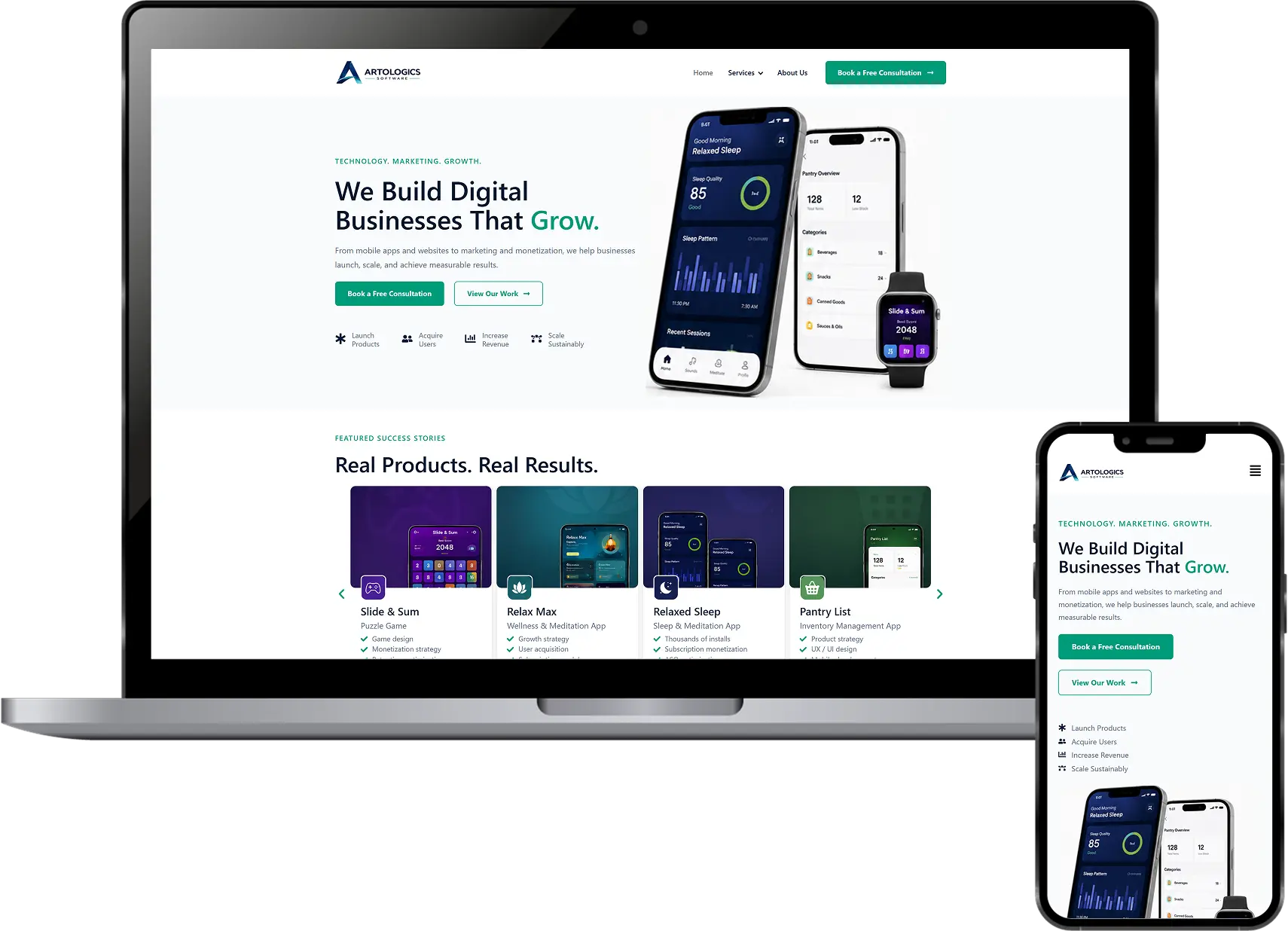
Project Overview
Artologics Software is a Canadian technology and digital growth company offering services across web development, mobile app development, SaaS development, UI/UX design, SEO, digital marketing, conversion optimization, and business strategy.
Because the company offers a broad range of services, the website needed more than a simple homepage. It required a structured multi-page system capable of presenting service categories, individual services, software products, website projects, case studies, testimonials, calls to action, and supporting content through one consistent visual experience.
My role was focused on WordPress development and frontend implementation. The designs were supplied to me, and I converted them into the finished website using WordPress, Elementor, and Elementor Pro.
This Artologics WordPress Development project required a consistent approach across multiple page types while keeping the website responsive, maintainable, and easy to expand.
Project Snapshot
- Client: Artologics Software
- Industry: Technology, Software & Digital Services
- Website Type: Multi-Page Corporate Website
- Platform: WordPress
- Page Builder: Elementor & Elementor Pro
- My Role: WordPress Developer
- Development Type: Design-to-WordPress Development
- Project Scope: Multi-page frontend website development
- Location: Canada
- Main Goal: Convert supplied designs into a responsive, scalable, and production-ready WordPress website
The Challenge
Artologics has a much larger service offering than a typical small business website. Its website needs to communicate services across development, marketing, growth, optimization, and consulting while also presenting software products and completed projects.
The main development challenge was keeping all of those pages visually connected. A website with many service pages can quickly feel inconsistent if typography, spacing, buttons, cards, content widths, imagery, and repeated components are handled differently from page to page.
The supplied desktop designs also needed to work properly on tablet and mobile devices. Responsive development therefore required more than simply reducing the width of desktop sections. Layouts, columns, spacing, text sizes, images, buttons, and navigation behavior needed to be adjusted carefully for different screen sizes.
Another priority was scalability. The WordPress implementation needed to support additional services, projects, and case studies without forcing the visual system to be rebuilt whenever new content was added.
Artologics WordPress Development Process
The Artologics WordPress Development process started with reviewing the supplied designs and identifying the main page types, repeated sections, visual patterns, and components that would be used throughout the website.
I then translated those designs into Elementor layouts while maintaining consistent typography, spacing, containers, buttons, cards, imagery, content structure, and calls to action.
Instead of treating each page as a completely separate build, I followed repeatable layout patterns wherever appropriate. This helped the website maintain a consistent visual language across service pages, project sections, case studies, testimonials, and conversion-focused areas.
Once the main desktop structures were developed, I refined the layouts for tablet and mobile devices. This included adjusting section spacing, column behavior, typography, image sizing, content order, navigation, and interactive elements to maintain usability across different screen sizes.
This type of structured implementation is also part of my broader WordPress development services, where the focus is on building websites that remain practical to manage after launch.
Design-to-WordPress Development
A major part of this project was accurately converting the supplied designs into a working WordPress website.
Design-to-WordPress development involves more than reproducing the visual appearance of a page. A static design does not define every responsive breakpoint, content variation, navigation state, reusable component, or editing requirement that becomes important once a website is functional.
I used the supplied visual direction as the foundation and implemented it in Elementor and Elementor Pro while making the necessary development decisions for responsive behavior and reusable website structures.
This allowed the finished website to maintain the intended design while functioning as a practical WordPress system rather than a collection of static layouts.
For projects that already have approved designs, I also provide dedicated Elementor development services for converting layouts into responsive WordPress websites.
Elementor and Elementor Pro Development
Elementor and Elementor Pro formed the core of the frontend development workflow for Artologics.
Throughout the Artologics WordPress Development project, I used Elementor Pro to translate the supplied design system into reusable and responsive frontend components.
I used the builder to create the website layouts while maintaining consistency across the different page types. Repeated components and visual patterns were structured so that related parts of the website followed the same design system.
My Elementor development work included:
- Homepage sections and layouts
- Service category pages
- Individual service pages
- Project showcase sections
- Case-study layouts
- Calls to action
- Testimonial sections
- Content cards and repeated components
- Header and footer implementation
- Navigation and service-menu structures
- Responsive desktop, tablet, and mobile layouts
- Typography and spacing consistency
- Reusable frontend sections
ElementsKit is also used alongside Elementor for additional functionality within the website.
Multi-Page WordPress Website Development
One of the strongest parts of the Artologics project is its scale. This was not a single landing page or a small brochure website.
The website supports a broad service structure covering different areas of the Artologics business, including:
- Web Development
- Mobile App Development
- UI/UX Design
- SaaS Development
- Search Engine Optimization
- Google Ads Management
- App Store Optimization
- Conversion Rate Optimization
- Content Strategy
- Technical SEO
- MVP Development
- Analytics & Tracking
- Monetization Strategy
- User Retention Strategy
- Subscription Optimization
Developing a website with this amount of content required consistent page structures and reusable visual patterns so visitors could move between different services without feeling like they had entered a completely different website.
Service Page Development
The service pages needed to explain individual Artologics capabilities while remaining consistent with the broader website.
I developed the supplied service designs in WordPress and maintained the same design language across hero areas, content sections, feature layouts, visual elements, process sections, supporting information, and calls to action.
Consistency was especially important because visitors may enter the website directly through an individual service page rather than the homepage. Each page therefore needed to work independently while still clearly belonging to the same Artologics website.
Project and Case Study Layouts
Artologics also uses the website to present software products, mobile applications, and website projects.
I developed the frontend structures used to showcase these projects and case studies while keeping their typography, imagery, content hierarchy, cards, buttons, and supporting sections aligned with the rest of the site.
The project presentation system gives Artologics a consistent way to showcase its work while preserving the visual identity established across its main service pages.
You can also view more WordPress projects to see other websites and optimization work I have completed.
Responsive WordPress Development
Responsive development was an important part of the Artologics website because complex multi-column layouts and large content sections need different behavior depending on the available screen space.
Desktop Development
Desktop layouts preserve the complete visual experience with larger content areas, multi-column sections, project showcases, navigation structures, imagery, and generous spacing.
Tablet Development
For tablet screens, I adjusted content widths, spacing, typography, columns, image sizes, and component positioning so sections remained balanced without feeling compressed.
Mobile Development
Mobile layouts required additional refinement to maintain readability and a clear user journey. I focused on clean content flow, readable typography, responsive images, appropriate spacing, stacked sections where necessary, usable buttons, and simplified component behavior.
The goal was to make the mobile experience feel intentionally developed rather than simply displaying a smaller version of the desktop layout.
Reusable Components and Consistent Styling
Maintaining consistency becomes increasingly important as a WordPress website grows.
I used repeatable development patterns for commonly used website elements so the same visual rules could be maintained across different pages.
These patterns included:
- Buttons and calls to action
- Heading styles
- Content containers
- Service cards
- Project cards
- Testimonial sections
- Image layouts
- Section spacing
- Content blocks
- Conversion sections
This approach improves consistency and also makes future page development easier because existing visual patterns can be reused instead of rebuilding every component from the beginning.
WordPress Technology Stack
The website uses WordPress as its content management system with Elementor as the primary frontend development environment.
- WordPress: Website content management system
- Elementor: Frontend page development
- Elementor Pro: Advanced layouts and reusable website structures
- ElementsKit: Additional Elementor components and functionality
- LiteSpeed Cache: Website caching and performance support
- Yoast SEO: On-page SEO and search optimization tools
- GTM4WP: Google Tag Manager integration
- Redirection: URL redirect management
- Really Simple Security: WordPress security functionality
The stack provides Artologics with a visual WordPress editing environment while supporting performance, SEO, analytics, URL management, and ongoing website maintenance.
Performance and Technical Structure
A visually strong website still needs a clean technical foundation. During development, I kept responsive layouts, asset usage, reusable sections, and frontend structure in mind so the site could remain practical as its content grows.
For WordPress websites that require deeper performance work, I also provide WordPress performance optimization focused on loading speed, Core Web Vitals, frontend efficiency, and overall user experience.
Technical structure also plays an important role in how search engines understand a website. My technical SEO services cover areas such as crawlability, indexing, internal structure, metadata, schema, redirects, and other technical SEO improvements.
Building the Website for Future Growth
A technology company's website rarely stays unchanged. New services may be introduced, existing capabilities may expand, and new projects or case studies may need to be published.
For this reason, I approached the development as a reusable website system rather than a collection of isolated pages.
Using consistent Elementor structures and repeatable frontend patterns makes it easier for future pages to follow the existing design language while reducing unnecessary development differences between sections.
This scalability was particularly important for Artologics because of the size and variety of its service offering.
Final Outcome
The final result is a responsive and scalable multi-page WordPress website that gives Artologics a consistent platform for presenting its technology, software, marketing, optimization, and consulting services.
The supplied designs were transformed into a working Elementor Pro website with structured service pages, project layouts, case studies, reusable sections, navigation, calls to action, and responsive behavior across desktop, tablet, and mobile devices.
The completed Artologics WordPress Development work provides a practical example of converting professional supplied designs into a structured multi-page Elementor website.
This Artologics WordPress Development project demonstrates my experience working beyond individual landing pages. It shows my ability to take an established design direction and turn it into a complete WordPress website with a large service architecture and a maintainable frontend system.
My Role and Responsibility
My contribution to this project was specifically focused on WordPress development, Elementor development, responsive frontend implementation, and design-to-WordPress conversion.
The applications, downloads, ratings, customer results, marketing achievements, and business statistics displayed on the Artologics website belong to Artologics and its clients. I do not present those results as outcomes created by my WordPress development work.
My portfolio case study focuses on the work I personally completed: translating the supplied designs into the finished website and creating the frontend WordPress implementation used to present Artologics' content, services, and projects.
Frequently Asked Questions
Who developed the Artologics WordPress website?
I developed the Artologics website in WordPress from supplied website designs. My work focused on Elementor and Elementor Pro development, responsive implementation, service-page construction, reusable components, navigation, and frontend consistency.
Was Artologics built with WordPress?
Yes. Artologics uses WordPress with Elementor and Elementor Pro for its frontend website structure and page development.
Did you design the Artologics website?
The website designs were supplied to me. My responsibility was converting those designs into the finished responsive WordPress website while maintaining the intended visual direction and creating the required frontend functionality.
Did you develop only the Artologics homepage?
No. The Artologics project involved broader multi-page WordPress development, including service layouts, project and case-study sections, reusable components, navigation, and responsive frontend implementation across the website.
What page builder was used for the Artologics website?
The website was developed primarily using Elementor and Elementor Pro. ElementsKit is also used for additional Elementor functionality.
What is design-to-WordPress development?
Design-to-WordPress development is the process of taking an existing website design and converting it into a working WordPress website. This includes building layouts, creating responsive behavior, implementing navigation, styling components, and making the final website functional across desktop, tablet, and mobile devices.
Can you convert supplied website designs into Elementor?
Yes. I develop WordPress websites from supplied designs using Elementor and Elementor Pro, with a focus on accurate frontend implementation, responsive behavior, reusable components, and maintainable page structures. You can learn more about my Elementor development service.
Can Elementor support a large multi-page website?
Yes. Elementor can support larger WordPress websites when global styling, reusable components, page structures, spacing systems, and responsive behavior are implemented consistently. The Artologics project is an example of using Elementor across a larger service-based website.
Do you provide ongoing WordPress development after launch?
Yes. I can help with additional page development, Elementor changes, responsive fixes, performance optimization, technical SEO improvements, troubleshooting, and ongoing website maintenance after the initial development is complete.